On the Arapiuns River, butterflies flutter by
They dance over the waters, and fill the sky
In the village of Sao Miguel, they radiate God's glory
They surround us as we listen, to the pastor's story
An illness left him paralyzed, for over a year
God humbled him and sent, an angel near
He touched the man's legs, and they were healed
Then a butterfly annointed him, and with the Spirit he was sealed
His glory fills the sky
His presence in this place (2x)
His glory fills the sky
May you receive God's grace
As a caterpillar is transformed, into a beautiful butterfly
We are reminded, of how You change our lives
Glory to Your name, for the work You've done
We pray that You will renew, more lives in the Amazon
His glory fills the sky
His presence in this place (2x)
His glory fills the sky
May you receive God's grace...
Saturday, January 28, 2006


Thursday, January 26, 2006
Found this prayer I wrote to God while going through my collection of theological articles.
March 25, 2003
"Oh Lord God, how great You are!
Your knowledge is immediate and simultaneous,
Your comprehension is always complete,
Your decree is simply one comprehensive plan, embracing all that comes to pass,
In this I rejoice!
You, God, have in Yourself all possible causes and results,
You chose what You wanted to bring to realization, and thus formed Your eternal purpose,
What is there that You do noot know?
Does anything surprise You?
No, there cannot be anything that comes to pass that You have not ordained.
To You be glory evermore, Amen."
(Much of this was inspired and taken from Berkhof's Systematic Theology; The Doctrine of God: The Divine Decrees in General, pg. 102)
After reading this, I picked up Berkhof and flipped through it. I forgot what it felt like to be immersed in such rich theological language. It is like getting high on God's glory. We should be intoxicated by it. It is always profitable to the soul to read on God's attributes.
March 25, 2003
"Oh Lord God, how great You are!
Your knowledge is immediate and simultaneous,
Your comprehension is always complete,
Your decree is simply one comprehensive plan, embracing all that comes to pass,
In this I rejoice!
You, God, have in Yourself all possible causes and results,
You chose what You wanted to bring to realization, and thus formed Your eternal purpose,
What is there that You do noot know?
Does anything surprise You?
No, there cannot be anything that comes to pass that You have not ordained.
To You be glory evermore, Amen."
(Much of this was inspired and taken from Berkhof's Systematic Theology; The Doctrine of God: The Divine Decrees in General, pg. 102)
After reading this, I picked up Berkhof and flipped through it. I forgot what it felt like to be immersed in such rich theological language. It is like getting high on God's glory. We should be intoxicated by it. It is always profitable to the soul to read on God's attributes.
Tuesday, January 24, 2006

Monday, January 23, 2006
This is worth my life, that is, the Gospel
It's becoming so clear for me. I know my purpose in life. I must go back to Brazil. It has been fuzzy for some time now. However, God has just been pounding it into my head and heart....Brazil is where God wants me. This is my fulfillment in life. This is not something I could have planned or wanted to. Honestly, when I first got back from my three-month stay on the Amazon, I wasn't sure if I could go back emotionally, and physically. Now, though, it is clear that I can't not go back. As I write this, my body is full of shivers. Not shallow shivers, but ones full of the realization of God's providence in ordaining all this to come to pass in my life. I posted a quote from John Piper a couple days ago. He said, "Do what is right, given what you can see to do, and let the chips fall where they will, and God will make a life for you and it will be wonderful." So, given what I see to do, this has got to be it. I don't know if I've felt this strongly about anything else before. While I was driving, God put these words into my head, "Find something worth dying for and start living for it." The truth of the Gospel is it. It is so worth dying for it, that it is what I want to live for. May God be merciful to me. May His will be done in my life. May I do His will only, not mine. Purge from me any selfish ambitions, Father!
Sunday, January 22, 2006
Oh, the glories...
 ...of ultimate frisbee.
A group of us went and played some tennis and UF. While going for a fast throw, the disc sliced my middle finger. Okay, so my precious disc was cracked...thanks, guys.
Note: This picture does not accurately depict the real grotesque hand I now find myself possessing.
A Pastoral Quiz
A Puritan's Mind has a good questionnaire for pastors. However, I thought it was helpful as a guide to look up useful information on the Bible and theology.
Saturday, January 21, 2006
Child of Providence
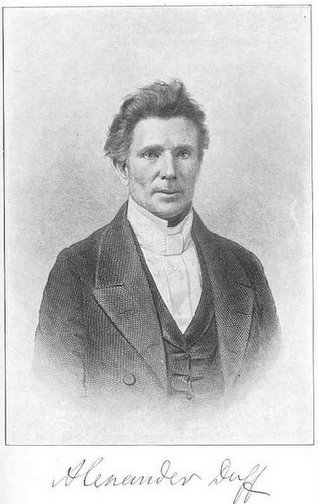 In 1806, Alexander Duff was born in Scotland. By age 24, he headed over to India to minister through education. God spared his life even through two shipwrecks on his way to there. He served almost 40 years in India. At the end of his life he wrote a letter to his daughter which read,
"Why should I, who have been the child of so many mercies, be faithless or doubting? If any man living should trust the Lord absolutely, I am that man. All my days, I have been a child of providence. The Lord leading me and guiding me in ways unknown to me, in ways His own and for the accomplishment of His own heavenly ends."
In reflecting over his own life, John Piper says,
"I didn't plan any of this. Don't think you can plan your life! Don't even think about it. Take it one step at a time and do what is right, given what you can see to do, and let the chips fall where they will, and God will make a life for you and it will be wonderful."
Thursday, January 19, 2006
Resolved: 2006
Carolyn Mahaney: True Beauty
Why do we chase after physical beauty?
-We lust for success, love, approval, and acceptance.
It is from the deep depths of sin in our hearts. Wickedness in our heart.
It does not produce happiness. Physical beauty does not = happiness. Many of even the most beautiful women in the world with perfect skin tone, body shapes, and Covergirl faces are not happy.
We must ask ourselves: Has my heart been captivated by the world’s expectation of beauty? Or, has my heart been captivated by God’s expectation of beauty?
Well, what is God’s expectation of beauty?
Proverbs 31:30 “Charm is deceitful, and beauty is vain, but a woman who fears the Lord is to be praised."
There is a beauty we are called to in Scripture.
1 Peter 3:4 “But let your adorning be the hidden person of the heart with the imperishable beauty of a gentle and quiet spirit, which in God's sight is very precious.”
“A gentle and quiet spirit.”
It’s what’s on the inside that matters.
It’s a beauty only God can see. This is extremely precious to God. This is a spirit which fears God and serves others.
Self-disciplined for the glory of God.
Do we have a preoccupation with self or God? Are we seeking our own glory or God’s glory?
Colossians 3:1 “If then you have been raised with Christ, seek the things that are above, where Christ is, seated at the right hand of God.”
Set your mind on Jesus.
Make the Lord the object of our affections and attentions!
Goals:
1. Acknowledge God’s providence.
Be grateful for how we’ve been created. A loving God determined long ago how we would be designed.
2. Recognize that my body is not my own.
It belongs to God. It is His holy temple.
3. Make it my ambition to serve others.
John Piper tells this exemplary story.
Why do we chase after physical beauty?
-We lust for success, love, approval, and acceptance.
It is from the deep depths of sin in our hearts. Wickedness in our heart.
It does not produce happiness. Physical beauty does not = happiness. Many of even the most beautiful women in the world with perfect skin tone, body shapes, and Covergirl faces are not happy.
We must ask ourselves: Has my heart been captivated by the world’s expectation of beauty? Or, has my heart been captivated by God’s expectation of beauty?
Well, what is God’s expectation of beauty?
Proverbs 31:30 “Charm is deceitful, and beauty is vain, but a woman who fears the Lord is to be praised."
There is a beauty we are called to in Scripture.
1 Peter 3:4 “But let your adorning be the hidden person of the heart with the imperishable beauty of a gentle and quiet spirit, which in God's sight is very precious.”
“A gentle and quiet spirit.”
It’s what’s on the inside that matters.
It’s a beauty only God can see. This is extremely precious to God. This is a spirit which fears God and serves others.
Self-disciplined for the glory of God.
Do we have a preoccupation with self or God? Are we seeking our own glory or God’s glory?
Colossians 3:1 “If then you have been raised with Christ, seek the things that are above, where Christ is, seated at the right hand of God.”
Set your mind on Jesus.
Make the Lord the object of our affections and attentions!
Goals:
1. Acknowledge God’s providence.
Be grateful for how we’ve been created. A loving God determined long ago how we would be designed.
2. Recognize that my body is not my own.
It belongs to God. It is His holy temple.
3. Make it my ambition to serve others.
John Piper tells this exemplary story.
Evelyn Harris Brand, the mother of Paul Brand, the world-renowned hand surgeon and leprosy specialist, grew up in a well-to-do English family. She had studied at the London Conservatory of Art and dressed in the finest silks. But she went with her husband to minister as missionaries in the Kolli Malai range of India. After about ten years her husband died at age 44 and she came home “a broken woman, beaten down by pain and grief.” But after a year's recuperation, and against all advice, she returned to India. Her soul was restored and she poured her life into the hill people, “nursing the sick, teaching farming, lecturing about guinea worms, rearing orphans, clearing jungle land, pulling teeth, establishing schools, preaching the gospel.” She lived in a portable hut, eight feet square, that could be taken down, moved and erected again.
At age 67 she fell and broke her hip. Her son, Paul, had just come to India as a surgeon. He encouraged her to retire. She had already suffered a broken arm, several cracked vertebrae and recurrent malaria. Paul mounted as many arguments as he could think of to persuade her that sixty-seven years was a good investment in ministry, and now it was time to retire. Her response? “Paul, you know these mountains. If I leave, who will help the village people? Who will treat their wounds and pull their teeth and teach them about Jesus? When someone comes to take my place, then and only then will I retire. In any case, why preserve this old body if it's not going to be used where God needs me?” That was her final answer. So she worked on.
At the age of 95 she died. Following her instructions, villagers buried her in a simple cotton sheet so that her body would return to the soil and nourish new life. “Her spirit, too, lives on, in a church, a clinic, several schools, and in the faces of thousandsof villagers across five mountain ranges of South India.” Her son commented that “with wrinkles as deep and extensive as any I have ever seen on a human face…she was a beautiful woman.” But it was not the beauty of the silk and heirlooms of London high society. For the last twenty years of her life she refused to have a mirror in her house! She was consumed with ministry, not mirrors. A coworker once remarked that Granny Brand was more alive than any person he had ever met. “By giving away life, she found it.” This is what happens, paradoxically, when ministry is more important than life. (Future Grace, John Piper, p 288)
Tuesday, January 17, 2006
One word: Explosive
 2500 18-35 year olds with passion for the supremacy of Christ and the sovereignty of God in one place at one time. Explosive.

Resolved: 2006
Oh yeah...it was awesome. More than that though, God is awesome. In these next few days I will be posting about the sermons given at the conference along with some pictures. This is a picture of my friend, Jessie (Jason's sister) and I waiting for the next preacher. The simple outline for posting will be this:
Rick Holland: Resolutions
John MacArthur: Prodigal Son (God's joy is greatest in redemption)
Carolyn Mahaney: True Beauty
Steve Lawson: Narrow Gate (the best gospel sermon I've ever heard)
C.J. Mahaney: Extravagent Devotion
Rick Holland: The Sacrifice of Isaac
Steve Lawson: Sovereign God
C.J. Mahaney: Sovereign Love
John MacArthur: Sufficiency of Scripture
 (L-R) Holland, MacArthur, Lawson, and Mahaney.
My hope is to write a bit about each sermon in the coming days. If I can't get to all of them, I'll pick my favorites (which is going to be hard to do).
Rick Holland: Resolutions
John MacArthur: Prodigal Son (God's joy is greatest in redemption)
Carolyn Mahaney: True Beauty
Steve Lawson: Narrow Gate (the best gospel sermon I've ever heard)
C.J. Mahaney: Extravagent Devotion
Rick Holland: The Sacrifice of Isaac
Steve Lawson: Sovereign God
C.J. Mahaney: Sovereign Love
John MacArthur: Sufficiency of Scripture
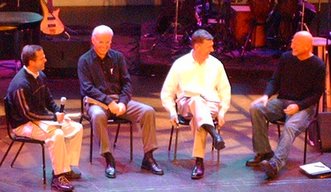 (L-R) Holland, MacArthur, Lawson, and Mahaney.
My hope is to write a bit about each sermon in the coming days. If I can't get to all of them, I'll pick my favorites (which is going to be hard to do).
Thursday, January 12, 2006
God bless!
I'm heading out for the Resolved Conference. God willing, I'll be back and blogging next Tuesday. May God richly bless you this weekend! And remember...
Soli Deo Gloria!
Soli Deo Gloria!
Tuesday, January 10, 2006
...And now back to our regularly scheduled theological posts...
"My brethren, let me say, be like Christ at all times. Imitate him in "public." Most of us live in some sort of public capacity—many of us are called to work before our fellow-men every day. We are watched; our words are caught; our lives are examined—taken to pieces. The eagle-eyed, argus-eyed world observes everything we do, and sharp critics are upon us. Let us live the life of Christ in public. Let us take care that we exhibit our Master, and not ourselves—so that we can say, 'It is no longer I that live, but Christ that lives in me.'"
—Charles Spurgeon
Monday, January 09, 2006
Guys...listen up!
"From nine years of watching the single scene at Bethlehem I'll tell you what I see and what I hear: there are a lot of intelligent, attractive, spiritual single women in this church who are not church hopping to find husbands and who trust God enough to be a happy single person if that is God's will. But 99% of these women would not mind it if a group of guys in this church took the initiative to get together with a group of them. (Twins game. Picnic in the park. Rent a good video and have pizza. Visit old-folks home. Take some inner city kids to the zoo.)
I stress the group approach just because the emotional stakes of being rejected are so much higher when you go it alone. It seems far more natural and helpful to me to let individual relationships grow out of a lot of group gatherings. And in both kinds of relationships it is the men who bear the responsibility for the pattern of initiative.
(And don't let your fears and inadequacies hinder you. The first time I ever tried to put my arm on the seat behind Noel I elbowed her in the eye. And look at us! Twenty years of marriage and I can hardly wait for her to get back from Guatemala.)" ~John Piper
Yes! Take it from a 19 year old gal: we love it when guys take the initiative. Now, I understand that us gals can make it difficult sometimes for you guys to take the lead. However, just do it! Don't let fear get in the way. Don't think that maybe the gals won't want you to take the lead. Maybe they don't, but they should want it, so do it. Be the man, and then maybe we'll be women. :~)
EDIT: Just for clarification: This post was intended to encourage GROUP activities. I am NOT suggesting that we need more one-on-one relationships. At least not among my real-life friends.
I stress the group approach just because the emotional stakes of being rejected are so much higher when you go it alone. It seems far more natural and helpful to me to let individual relationships grow out of a lot of group gatherings. And in both kinds of relationships it is the men who bear the responsibility for the pattern of initiative.
(And don't let your fears and inadequacies hinder you. The first time I ever tried to put my arm on the seat behind Noel I elbowed her in the eye. And look at us! Twenty years of marriage and I can hardly wait for her to get back from Guatemala.)" ~John Piper
Yes! Take it from a 19 year old gal: we love it when guys take the initiative. Now, I understand that us gals can make it difficult sometimes for you guys to take the lead. However, just do it! Don't let fear get in the way. Don't think that maybe the gals won't want you to take the lead. Maybe they don't, but they should want it, so do it. Be the man, and then maybe we'll be women. :~)
EDIT: Just for clarification: This post was intended to encourage GROUP activities. I am NOT suggesting that we need more one-on-one relationships. At least not among my real-life friends.
Saturday, January 07, 2006
The Wedding
 Well, it's happened. I never thought this day would come. I'm officially...full. My friend, Rebekah, has finally tied the knot with John. Maybe I shouldn't say "finally." She is only a couple months younger than I. She turns 19 in 5 days.
This is the first wedding I've been to when they've been my own age. I can't imagine getting married now. Well, maybe if there was the right guy...anyway, they are super-happy :)
And my stomach is happy. The cake was delicioso! (That means it was very, very good. I'm a tough critic. Not much of a cake fan...just give me some guacamole and chips and you'll make me happy :)
May God bless these two with a God-centered marriage!
"God has designed this trial for my good"
 Just found out last night that John Piper has just recently been diagnosed with prostate cancer. You can read his God-centered, Christ-exalting letter here. Please pray for him and Noel.
John's books, DVD's, and CD's have been a huge part of my life. His passion for the glory of God and the supremacy of Christ is infectious. May the grace of God ever shine on him.
Thanks, Jo, for bringing this to my attention.
Friday, January 06, 2006

Prophecy Update
I can't believe I am just now remembering this. We had our annual prophecy update last Sunday. You just have to know what's going to happen:
- Jesus is coming back
- No one knows when (hence the "thief in the night" bit)
- Live like it's today
Hope you guys can get back to your regularly scheduled day.
:)
Wednesday, January 04, 2006
Why Evangelism makes sense from a Reformed Perspective
1. Evangelism is the activity of publishing, or announcing, the "evangel" or, the gospel ( i.e. the glad tidings of Jesus the Christ, crucified and risen).
2. God sent His only begotten Son to die for all those, and those only, whom He had given to Christ as His people, effectively to redeem them, by atoning for their sins.
3. The Reformed perspective holds that all men alike are, because the fall of Adam, dead in sin and slaves to a sinful nature, having wills that are not free to be able to choose Christ and salvation, but bound to be incapable of doing any else, except to reject the Christ presented in the gospel.
4. God now efficaciously calls, by the gospel and the Holy Spirit, into saving fellowship with Jesus, all those, and only those, whom He chose and redeemed. The Holy Spirit brings about a "new birth" in His elect when outwardly hearing the Gospel being preached. These elect will never be cast out. "All that the Father gives me will come to me, and whoever comes to me I will never cast out." John 6:37
In a simple outline:
a. God commands us to go into all the world and preach the Good News.
b. Jesus paid the penalty of all sin of all those the Father gave Him.
c. We can freely preach the Gospel because we know it is not of us, but of how the Spirit moves which will bring about conversion.
d. God will draw all His elect unto Himself out of every tribe, tongue and nation.
Evangelism is just another great example of the working of the Trinity. The Father elects, the Son redeems, the Spirit awakens. Thank you God, for the Work you do in our lives and of those whom you know!
1. Evangelism is the activity of publishing, or announcing, the "evangel" or, the gospel ( i.e. the glad tidings of Jesus the Christ, crucified and risen).
2. God sent His only begotten Son to die for all those, and those only, whom He had given to Christ as His people, effectively to redeem them, by atoning for their sins.
3. The Reformed perspective holds that all men alike are, because the fall of Adam, dead in sin and slaves to a sinful nature, having wills that are not free to be able to choose Christ and salvation, but bound to be incapable of doing any else, except to reject the Christ presented in the gospel.
4. God now efficaciously calls, by the gospel and the Holy Spirit, into saving fellowship with Jesus, all those, and only those, whom He chose and redeemed. The Holy Spirit brings about a "new birth" in His elect when outwardly hearing the Gospel being preached. These elect will never be cast out. "All that the Father gives me will come to me, and whoever comes to me I will never cast out." John 6:37
In a simple outline:
a. God commands us to go into all the world and preach the Good News.
b. Jesus paid the penalty of all sin of all those the Father gave Him.
c. We can freely preach the Gospel because we know it is not of us, but of how the Spirit moves which will bring about conversion.
d. God will draw all His elect unto Himself out of every tribe, tongue and nation.
Evangelism is just another great example of the working of the Trinity. The Father elects, the Son redeems, the Spirit awakens. Thank you God, for the Work you do in our lives and of those whom you know!
Sunday, January 01, 2006
I want to call your attention to the Westminster Shorter Catechism for today. It reads:
Q. 1.What is the chief end of man?
A. Man's chief end is to glorify God, and to enjoy him forever.
It is the first question in the catechism which is fitting to be on the first day of this year. May we remember what our purpose is: to glorify God and enjoy Him forever! Amen.
Q. 1.What is the chief end of man?
A. Man's chief end is to glorify God, and to enjoy him forever.
It is the first question in the catechism which is fitting to be on the first day of this year. May we remember what our purpose is: to glorify God and enjoy Him forever! Amen.
Gingerbread Girl
 Eventhough it is after Christmas, I thought I'd share with you this photo of Ginger playing the part of the Gingerbread Girl.
Just thinking, this blog mostly consists of Reformed theology and pictures of dogs. Pretty cool, eh?
Subscribe to:
Posts (Atom)